
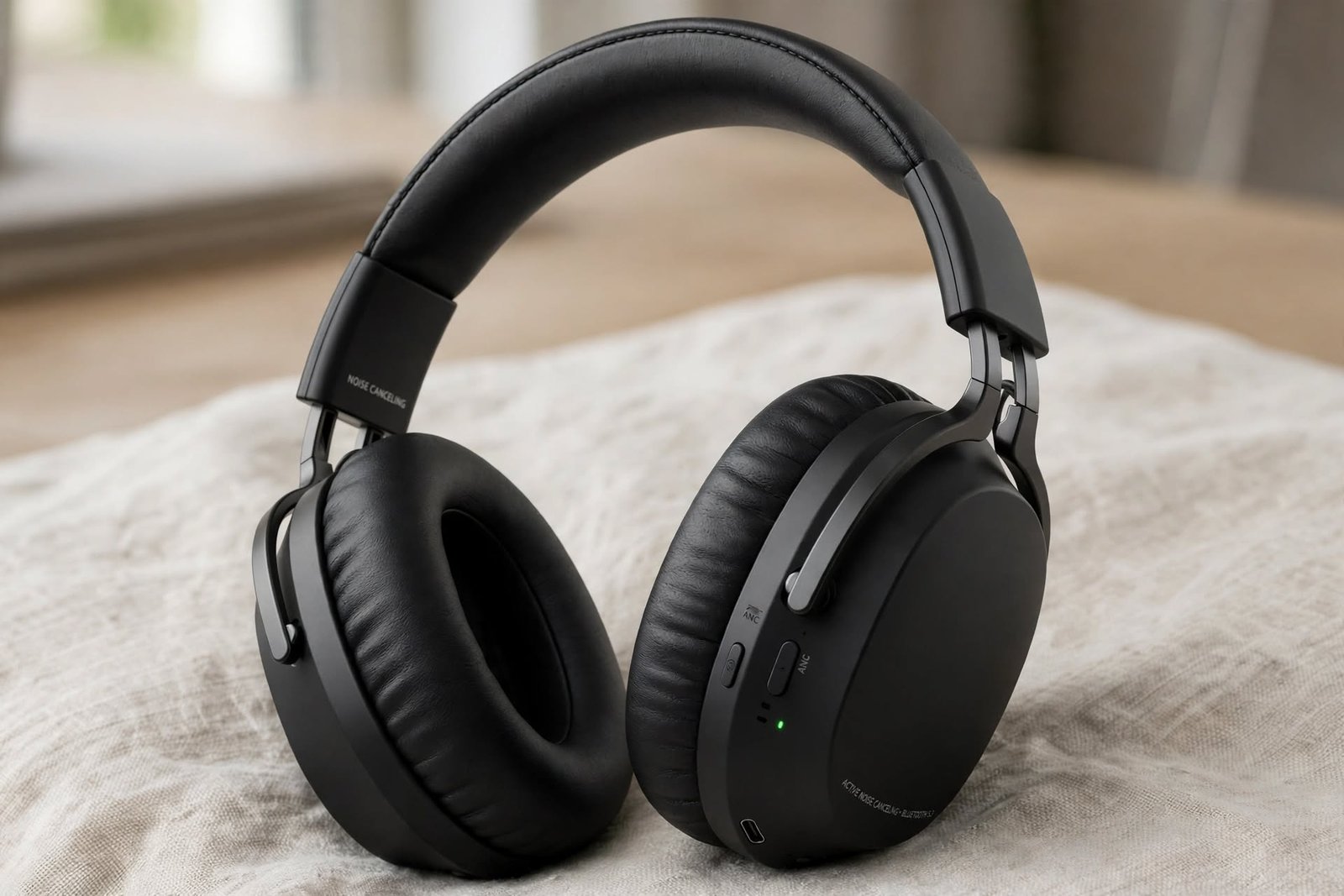
Over-Ear Noise-Canceling Headphones: Acoustic Engineering, ANC Technology, and Modern Design
Over-ear noise-canceling headphones have evolved from niche aviation accessories into everyday essentials for commuters, remote workers, travelers, and audiophiles. By combining physical acoustic isolation with real-time digital signal processing, these devices carve out a quiet personal listening environment even inside roaring airplane cabins, bustling city trains, or open-plan offices. Understanding how they work requires looking closely at their physical architecture, transducer design, active noise cancellation (ANC) algorithms, and wireless audio transmission.
Physical Design and Passive Isolation
Before a single battery-powered circuit turns on, over-ear headphones, formally known as circumaural headphones, rely on physical design to block ambient sound. Unlike on-ear (supra-aural) models that rest directly on the pinna of the ear, over-ear designs feature large earcups that completely surround the outer ear and rest against the sides of the head.
This structure serves two critical functions: comfort and passive noise isolation. Ear pads crafted from high-density memory foam wrapped in protein leather, sheepskin, or breathable microfiber conform to the contours of the wearer’s skull and jawline, forming an acoustic seal. Because sound travels as pressure waves through the air, a tight seal physically reflects and absorbs higher-frequency environmental noises—such as human speech, keyboard clatter, and rustling papers—before they ever reach the ear canal.
Most over-ear noise-canceling headphones use a closed-back enclosure. Unlike open-back audiophile headphones, which allow air and sound to pass freely through perforated earcups for a wider soundstage, closed-back cups feature solid outer shells lined with internal damping materials. These materials absorb stray internal reflections and prevent outside noise from leaking in (and music from leaking out). However, because a closed cup traps air pressure, engineers must carefully tune small acoustic vents and bass ports so the headphone drivers can move freely without creating an uncomfortable “cabin pressure” sensation on the eardrums.
Inside the Earcup: Drivers and Acoustic Tuning
At the heart of every headphone is the transducer (commonly called a driver), which converts electrical audio signals into mechanical vibrations that move air. Most over-ear ANC headphones use dynamic drivers ranging from 30 mm to 50 mm in diameter.
A dynamic driver consists of a permanent magnet, a voice coil, and a lightweight diaphragm—often made from composite polymers, bio-cellulose, or metal-coated films like beryllium or titanium. When alternating current from the headphone’s internal amplifier passes through the voice coil, it generates a fluctuating magnetic field that pushes and pulls the diaphragm, reproducing frequencies across the audible spectrum. Some high-end models alternatively employ planar magnetic drivers, which use an ultra-thin, flat membrane suspended between arrays of magnets for faster transient response and lower harmonic distortion, though these tend to be heavier and more power-hungry.
Because ANC circuitry alters the acoustic environment inside the earcup, modern headphones rely heavily on Digital Signal Processing (DSP) to shape their frequency response. Built-in microphones can even monitor the acoustics inside the earcup in real time, adjusting equalization dynamically to compensate for variations in head shape, hair thickness, or glasses frames that might slightly break the ear pad seal.
How Active Noise Cancellation (ANC) Works
While passive isolation excels at blocking high-frequency sounds (generally above 1,000 Hz), low-frequency waves like the deep drone of jet engines, HVAC systems, or traffic rumble have long wavelengths that easily penetrate solid earcups. This is where Active Noise Cancellation steps in, using a physics principle called destructive interference.
Sound waves consist of alternating peaks (compression) and troughs (rarefaction). If an audio system detects an incoming noise wave and instantly generates a second sound wave of the same amplitude but inverted phase (180 degrees out of phase), the peaks of one wave align with the troughs of the other. When the two waves collide in the air inside the earcup, they cancel each other out, resulting in silence or a dramatically reduced noise floor.
To execute this in milliseconds, ANC headphones utilize specialized micro-electromechanical systems (MEMS) microphones and dedicated ANC processor chips arranged in three main architectures:
- Feedforward ANC: Microphones placed on the outside of the earcups capture ambient noise before it reaches the ear. The processor calculates the inverse wave and sends it to the speaker driver just as the outside noise penetrates the earcup. Feedforward systems are effective across a broad frequency range, particularly midrange sounds, but can be sensitive to wind noise and cannot verify whether the cancellation actually succeeded.
- Feedback ANC: Microphones placed inside the earcup, directly in front of the driver, listen to the residual noise that makes it past the ear pad—along with the music itself. The processor filters out the music signal and generates an anti-noise wave to eliminate the remaining ambient sound. Feedback ANC adapts well to fit variations and suppresses deep bass rumble effectively, though it operates over a narrower frequency bandwidth and can produce whistling feedback if pushed too aggressively.
- Hybrid ANC: The gold standard in modern flagship headphones combines both feedforward and feedback microphones on each earcup. Exterior mics anticipate incoming sound, while interior mics verify the result and clean up whatever slips through. Hybrid systems deliver the widest, deepest noise reduction without sacrificing audio fidelity.
Adaptive ANC and Transparency Modes
Modern ANC systems go beyond static cancellation. Adaptive ANC continuously samples the environment—adjusting cancellation strength automatically when moving from a quiet library onto a noisy subway platform—and monitors seal integrity to prevent low-frequency booming.
Conversely, because total acoustic isolation can be unsafe when crossing streets or inconvenient during brief conversations, virtually all ANC headphones feature a Transparency (or Ambient Aware) Mode. By routing the external feedforward microphones directly into the internal drivers at a calibrated volume, the headphones allow outside sound to pass through naturally, often sounding as if the wearer isn’t wearing headphones at all.
Wireless Connectivity, Codecs, and Battery Life
Because the vast majority of modern over-ear ANC headphones are wireless, Bluetooth architecture plays a central role in sound quality and usability. Digital audio must be compressed to fit within Bluetooth’s bandwidth limits, a process handled by audio codecs:
- SBC and AAC: The universal baseline codecs. SBC is supported by all Bluetooth devices, while AAC is optimized for Apple ecosystems, offering reliable efficiency at moderate bitrates.
- aptX Adaptive and aptX Lossless: Developed by Qualcomm, these codecs dynamically scale bitrates based on wireless interference, supporting high-resolution audio and low-latency modes for video or gaming.
- LDAC: Developed by Sony and natively supported on Android, LDAC transmits data at up to 990 kbps—roughly three times the bitrate of standard Bluetooth—preserving finer detail in high-resolution tracks.
- LE Audio and LC3: The newer Bluetooth Low Energy audio standard uses the LC3 codec to deliver higher audio quality at significantly lower bitrates, extending battery life and enabling features like Auracast broadcast audio.
Many over-ear ANC headphones also support wired listening via a 3.5 mm analog jack or USB-C digital audio, allowing listeners to bypass Bluetooth compression entirely—and even listen passively if the battery runs out. Thanks to efficient System-on-Chip (SoC) processors and spacious earcup housings capable of holding high-capacity lithium-ion cells, contemporary models routinely achieve 25 to 60 hours of continuous playback with ANC active.
Ergonomics and Key Trade-Offs
Designing over-ear noise-canceling headphones requires balancing competing engineering priorities:
- Clamping Force vs. Comfort: A firm clamping force ensures a tight acoustic seal for maximum bass response and passive isolation, yet excessive pressure causes jaw fatigue and heat buildup during multi-hour flights. Weight distribution across the headband—often under 260 to 300 grams for travel-focused models—is crucial for long-term wearability.
- ANC Strength vs. Sound Quality: Early noise-canceling headphones suffered from an audible background hiss and thin, compressed music reproduction whenever ANC was engaged. Modern DSP algorithms keep music signals cleanly separated from anti-noise waves, though purists still note subtle tonal shifts between ANC-on, ANC-off, and passive wired modes.
- Portability vs. Durability: Hinges that allow earcups to fold flat or collapse into compact travel cases make headphones easier to pack, whereas rigid single-piece yokes often provide greater long-term structural durability.
Over-ear noise-canceling headphones represent a sophisticated marriage of acoustic engineering and real-time computation. By pairing well-sealed closed-back enclosures and tuned dynamic drivers with hybrid microphone arrays, adaptive DSP, and high-efficiency wireless codecs, they transform chaotic acoustic environments into controlled personal soundstages. Whether used to focus in a busy workspace, protect hearing from the fatigue of low-frequency travel drone, or enjoy nuanced music detail uninterrupted, they stand as one of the most practical advancements in personal audio technology.